

The Autumn Roots of Resilience: The Ancient Use of American Ginseng for Burnout
As autumn arrives, nature reminds us that restoration is as important as growth. Trees shed their leaves, animals conserve energy, and the earth quietly prepares for winter. Yet in modern life, many people move in the opposite direction, pushing harder through exhaustion, stress, and emotional depletion. Burnout has become one of the defining health challenges of our era. Long before terms like "adrenal fatigue" or "occupational burnout" entered our vocabulary, traditional healers sought natural ways to replenish depleted energy and restore resilience. Among the most valued of these remedies was American ginseng (Panax quinquefolius).
A Root with a Deep History
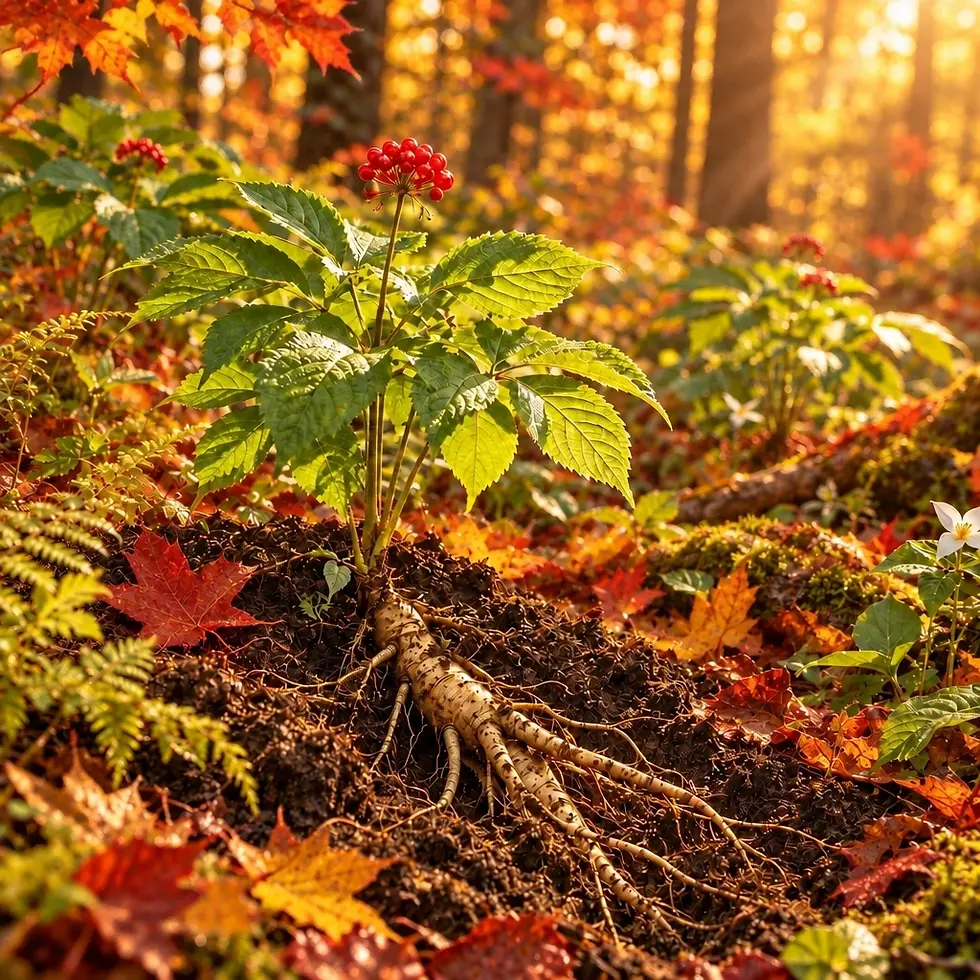
American ginseng is native to the rich hardwood forests of eastern North America, where it has been used for centuries by Indigenous peoples. Tribes such as the Cherokee, Iroquois, and Creek recognized the root's restorative qualities and used it for weakness, fatigue, digestive complaints, and general wellness.
What many people do not realize is that American ginseng also played a remarkable role in the economic history of the United States. Following the American Revolution, merchants discovered that Chinese consumers highly valued American ginseng as a substitute for Asian ginseng. In 1784, the ship Empress of China sailed from New York carrying a cargo of American ginseng, helping establish the first direct trade route between the newly independent United States and China. The voyage was highly successful and demonstrated the enormous commercial value of this Appalachian forest herb. [newengland...ociety.com], [america.cgtn.com], [hekint.org]
For generations thereafter, American ginseng remained one of the most important natural products exported from North America to China. Throughout the nineteenth century, families in the Appalachian Mountains harvested wild ginseng to supplement their income, purchase necessities, pay taxes, and support their households during economically challenging times. [unitedplan...savers.org], [jstor.org]
Thus, American ginseng became more than a medicinal plant. It served as a bridge between Indigenous knowledge, Chinese medical traditions, and the emerging American economy.
Understanding Burnout Through Traditional Chinese Medicine
Traditional Chinese Medicine (TCM) does not describe burnout in modern psychological terms. Instead, symptoms associated with burnout are often understood as patterns of deficiency and depletion. Common signs include:
Persistent fatigue despite rest
Mental fog and poor concentration
Emotional exhaustion
Irritability
Low motivation
Sleep disturbances
Increased susceptibility to illness
From a TCM perspective, these symptoms frequently reflect deficiencies of Qi, Yin, or both. Chronic stress consumes the body's vital resources much like a candle burning at both ends. Over time, the body loses its ability to adapt, recover, and maintain balance.
American ginseng has traditionally been valued because it replenishes energy without creating excessive stimulation. Unlike substances that temporarily mask fatigue, it is believed to support recovery by nourishing the body's underlying reserves.
Why Autumn Is the Season of Restoration
The timing of ginseng harvest carries symbolic significance. Mature American ginseng roots are traditionally harvested in autumn after the plant's aerial growth has faded. During this period, the plant directs much of its energy back into the root system.
Traditional herbalists viewed this seasonal cycle as a reflection of an important healing principle: true strength comes not from constant outward activity, but from the ability to gather and preserve energy.
As daylight shortens and temperatures cool, autumn naturally encourages introspection, rest, and conservation. For individuals experiencing burnout, this season can serve as a reminder to shift from relentless productivity toward restoration.

American Ginseng as an Adaptogenic Ally
Modern herbalists often classify American ginseng as an adaptogen, a substance thought to help the body adapt to physical and emotional stress.
Historically, practitioners used American ginseng for individuals who appeared depleted rather than overstimulated. Its traditional applications included:
Supporting physical stamina during recovery
Enhancing mental clarity
Promoting balanced energy
Strengthening resistance to stress
Supporting healthy immune function
American ginseng is generally considered gentler and more cooling than Asian ginseng, making it a preferred choice for individuals who experience stress accompanied by irritability, restlessness, or feelings of being overheated from prolonged mental strain.
Scientific Evidence Supporting American Ginseng and Resilience
The traditional reputation of American ginseng as a restorative tonic has increasingly attracted the attention of researchers.
One of the most influential studies was "Wisconsin Ginseng (Panax quinquefolius) to Improve Cancer-Related Fatigue: A Randomized, Double-Blind Trial, N07C2", published in the Journal of the National Cancer Institute. In this randomized controlled trial involving 364 participants, researchers found that individuals receiving American ginseng experienced significantly greater improvements in fatigue compared with the placebo group after eight weeks of use. The investigators concluded that American ginseng provided benefit for fatigue with no significant increase in toxicity. [pubmed.ncb...lm.nih.gov]
This landmark study built upon earlier research titled "Pilot Study of Panax quinquefolius (American Ginseng) to Improve Cancer-Related Fatigue: A Randomized, Double-Blind, Dose-Finding Evaluation", which helped establish optimal dosing and demonstrated promising early results for fatigue reduction. [ons.org]
Researchers have also examined the broader effects of ginseng on energy and physical performance. In the study "Efficacy of Ginseng Supplements on Fatigue and Physical Performance: A Meta-Analysis", published in the Journal of Korean Medical Science, investigators reviewed multiple clinical trials and concluded that ginseng supplementation may provide meaningful benefits for fatigue. [ons.org]
Beyond physical endurance, scientific investigations suggest that American ginseng may support cognitive function. Research summarized by the Oncology Nursing Society has reported improvements in aspects of working memory and mental performance, areas that are particularly relevant to individuals struggling with the "brain fog" commonly associated with chronic stress and burnout. [ons.org]
Scientists attribute many of these effects to compounds known as ginsenosides, unique plant constituents that appear to influence stress-response systems, inflammation pathways, immune function, and metabolic regulation. These mechanisms may help explain why American ginseng has long been considered a plant that supports resilience rather than merely providing temporary stimulation. [ons.org], [medicalherbalist.org]
The Wisdom of Sustainable Energy
One reason American ginseng remains relevant today is that it embodies a different philosophy of vitality. Modern culture often encourages people to overcome fatigue with stimulants, energy drinks, or sheer determination. While these approaches may provide temporary relief, they frequently fail to address the deeper imbalance that develops from chronic stress. Traditional healing systems emphasize a different goal: rebuilding resilience from the inside out.
In this context, American ginseng symbolizes sustainable energy. Rather than pushing the body to perform beyond its limits, it has historically been used to support the gradual restoration of strength, mental focus, and adaptability.
Integrating Ancient Wisdom into Modern Life
Burnout is rarely caused by a single factor, and no herb alone can resolve chronic exhaustion. Lasting recovery often requires restorative sleep, balanced nutrition, meaningful relationships, stress management, movement, and periods of deliberate rest.
Yet the enduring history of American ginseng reminds us of an important truth: resilience is not simply the ability to tolerate more stress. It is the capacity to recover from stress.
Remarkably, this humble woodland root has traveled an extraordinary journey, from Indigenous healing traditions to Chinese herbal medicine, from Appalachian forests to international trade routes, and from ancient wisdom into modern clinical research. Across centuries and cultures, American ginseng has maintained a reputation as a plant that helps restore what has been depleted.
Conclusion
The ancient use of American ginseng offers more than a historical curiosity. It provides a timeless lesson about health itself. In a world that celebrates constant productivity, the root teaches the value of replenishment.
Modern science is beginning to validate what generations of healers observed long ago. Studies such as "Wisconsin Ginseng (Panax quinquefolius) to Improve Cancer-Related Fatigue: A Randomized, Double-Blind Trial" suggest that American ginseng may help improve fatigue, support cognitive performance, and enhance the body's ability to adapt during times of prolonged physiological stress. [pubmed.ncb...lm.nih.gov], [ons.org]
Like the forests where it quietly grows, resilience develops not through relentless activity, but through cycles of effort, recovery, and renewal. As autumn settles in and nature turns inward, American ginseng stands as a powerful reminder that restoration is not weakness. It is the foundation of lasting strength.
Selected Scientific References
Barton DL, Liu H, Dakhil SR, et al. Wisconsin Ginseng (Panax quinquefolius) to Improve Cancer-Related Fatigue: A Randomized, Double-Blind Trial, N07C2. Journal of the National Cancer Institute. 2013. [pubmed.ncb...lm.nih.gov]
Barton DL, Soori GS, Bauer BA, et al. Pilot Study of Panax quinquefolius (American Ginseng) to Improve Cancer-Related Fatigue: A Randomized, Double-Blind, Dose-Finding Evaluation. Supportive Care in Cancer. 2010. [ons.org]
Bach HV, Kim J, Myung SK, Cho YA. Efficacy of Ginseng Supplements on Fatigue and Physical Performance: A Meta-Analysis. Journal of Korean Medical Science. 2016. [ons.org]

Comments